
What Your Sleep Is Telling You About Your Cycle
Your menstrual cycle shows up in your sleep, temperature and heart rate every month. Here's what those signals mean and how a smart ring reads them while you rest.
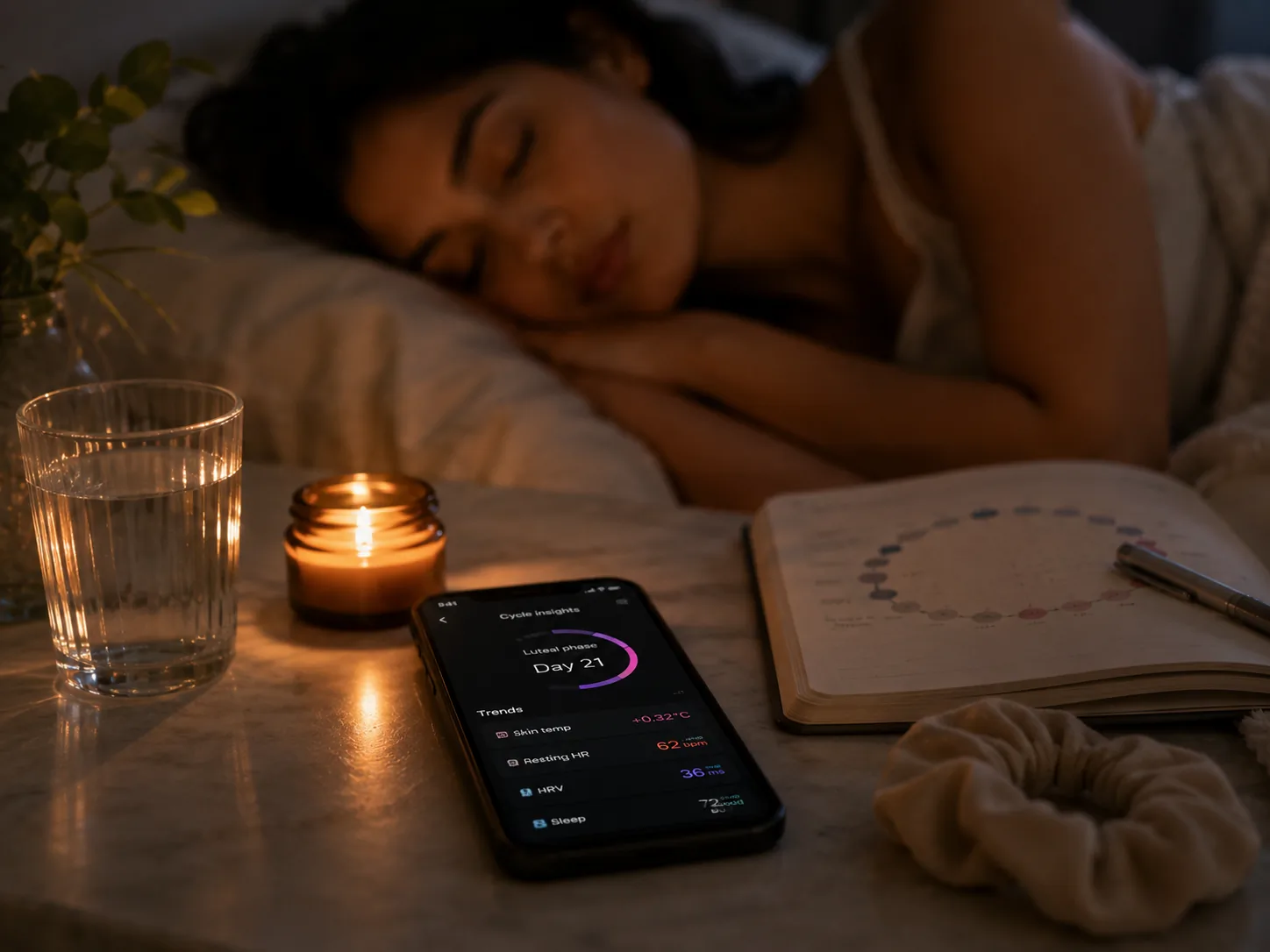
Some weeks you sleep like a stone. Other weeks you run warm, wake at 3am for no reason, and drag yourself through the next day wondering what you did wrong. Often the answer is nothing. You're just in a different part of your cycle.
Your menstrual cycle leaves a trail every month, in your sleep, your body temperature, and your heart rate. Most of us were never taught to read it. Here's what those signals mean, and how a device you wear while you sleep can show them to you.
Does your menstrual cycle affect your sleep?
Yes. Sleep tends to be most settled in the first half of your cycle and more broken in the week or so before your period, when rising progesterone lifts your body temperature and can fragment sleep. Many women notice more night waking, lighter sleep, and vivid dreams premenstrually, then a return to deeper sleep once the period begins.
None of that is a personal failing or a sign you've slept badly. It's a predictable hormonal shift, and once you can see it coming, it stops feeling so random.
The signals your body shifts across the month
Four things move on a monthly rhythm, and a ring worn overnight can read all four.
Body temperature
After ovulation, progesterone raises your resting body temperature by roughly 0.3°C and keeps it up through the second half of the cycle, until it drops back around your period. This is the single clearest signal of where you are in your cycle, and it's exactly what a ring's overnight temperature sensor picks up.
Resting heart rate
Your resting heart rate tends to sit at its lowest around and just after your period, then climbs through the second half of the cycle, often peaking in the days just before your period, usually by a few beats a minute. A ring measures this while you sleep, when your heart rate is most stable.
Heart rate variability
Heart rate variability, a common marker of recovery, tends to be higher in the first half of your cycle and lower in the luteal phase before your period. So if your recovery score dips premenstrually, it may be your hormones, not your habits. That's useful to know before you blame yourself for a rough week.
Sleep quality
Sleep is often at its best in the mid-follicular phase, the week or so after your period, and at its most disrupted in the late luteal phase just before bleeding starts. The temperature rise is part of why. A warmer body is a lighter sleeper.
A rough map of your cycle in your data
Every body is different, and cycles vary in length, but the overall shape usually looks something like this.
| Phase | Roughly when | What your body does | What you might notice |
|---|---|---|---|
| Menstrual | Days 1 to 5 | Temperature and resting heart rate at their lowest | Low energy early, then often a lift |
| Follicular | After your period to ovulation | HRV higher, sleep often deepest | Steadier energy and mood |
| Ovulation | Around mid-cycle | A small temperature shift begins | A brief peak in energy |
| Luteal | The roughly two weeks before your period | Temperature up, resting heart rate up, HRV down | Warmer nights, lighter sleep, lower recovery |
Why is your resting heart rate higher before your period?
Your resting heart rate is higher before your period because progesterone rises in the luteal phase and gently pushes up both your heart rate and your body temperature. It's a normal cyclical change, often just a few beats a minute, and it usually settles once your period starts.
Can a smart ring track your cycle?
Yes, and in a different way than a calendar app. Instead of asking you to remember and log dates, a smart ring reads the overnight temperature and heart-rate shifts that mark ovulation and the luteal phase, and uses those patterns to estimate where you are in your cycle and when your next period is likely. In effect it reads the shifts instead of asking you to log them.
One important note: this is wellness insight, not a medical diagnosis, and it is not a method of contraception. It's a way to understand your body's rhythm, not to make clinical or family-planning decisions.
What this is genuinely useful for
Reading your cycle in your data is useful for planning around your own energy, resting when your body is asking for it, and understanding that a low-recovery, poor-sleep week before your period is physiology, not laziness. Over time it also helps you spot what is normal for you, so that a real change stands out.
It is not a substitute for medical care. If your cycle changes a lot, becomes very painful, or something simply feels off, that's a conversation for a doctor, not a wearable.
A gentler way to read your own data
The point of all this isn't to optimise every number or to chase a perfect recovery score. It's to stop treating your body like it's malfunctioning when it's simply doing what it does every month. Feeling tired and warm and a little flat before your period is not a problem to fix. It's information.
This is part of what Wualt is built around: a ring that quietly reads your sleep, temperature and heart rate, shows you your cycle without any daily logging, and helps the month make sense instead of catching you by surprise.
FAQs
Is it normal to sleep worse before my period? Yes. Lighter, more broken sleep in the days before your period is very common, largely because your body temperature is running higher in the luteal phase.
How many days before my period does my heart rate rise? It usually climbs gradually through the luteal phase and is often at its highest in the few days before bleeding starts, though the exact timing varies from person to person.
Does everyone's cycle show up the same way in the data? No. Some people see very clear temperature and heart-rate patterns, others see subtler ones. The value comes from watching your own trend over a few cycles, not from comparing to anyone else.
Can I use my cycle data as birth control? No. Cycle insights from a wearable are for understanding your body, not for preventing or planning pregnancy. Use a proper method and speak to a clinician for that.
The takeaway
Your cycle isn't only the few days you bleed. It's a monthly rhythm running through your sleep, your temperature and your heart, and reading it can make the whole month feel less like a mystery.
Wualt is building a ring that shows you all of this quietly, and keeps you safe at the same time. Pre-order Wualt


